EKHA Webinar From Care to cure, an EU wide Network, Advancing Rare Kidney Disease healthcare and research, July 7, 2026
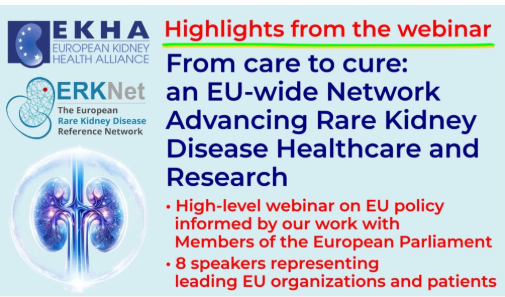
FEDERG at the EKHA Webinar: From Care to Cure – An EU-wide Network Advancing Rare Kidney Disease Healthcare and Research
FEDERG, the Federation of European Associations of Patients with Rare and Genetic Kidney Diseases, is pleased to participate in the EKHA webinar “From Care to Cure: An EU-wide Network, Advancing Rare Kidney Disease Healthcare and Research.”
Rare kidney diseases often begin in childhood, and for many young patients, living with a rare condition means navigating complex diagnostic pathways, specialised care and treatments that are not always specifically designed or adapted to their needs.
During the webinar, FEDERG will bring the patient and family perspective to the discussion, highlighting the urgent need for child-friendly and age-appropriate treatments for children living with rare kidney diseases. Developing treatments for children requires taking into account their specific medical, developmental and psychosocial needs, as well as ensuring appropriate formulations, dosing, administration methods and long-term safety.
From the patient perspective, moving “from care to cure” also means ensuring that innovation reaches children and families in a meaningful and equitable way. Research and clinical development should involve patients and families from the earliest stages, helping researchers and healthcare professionals better understand the outcomes that matter most to them.
FEDERG will advocate for a European approach that strengthens collaboration between patients, families, clinicians, researchers, industry and policymakers, supporting the development of innovative therapies and ensuring that children with rare kidney diseases are not left behind.
Every child living with a rare kidney disease deserves access to treatments designed with their needs in mind. By bringing together expertise and the patient voice across Europe, we can help move from better care towards better treatments and, ultimately, better outcomes for children and their families