
“The enormous importance of early diagnosis and treatment adapted for young children allowed us to protect his kidney function for years.”
Pathology
Primary Familial Hypomagnesemia with Hypercalciuria and Nephrocalcinosis without Severe Ocular Involvement. FHHN, ORPHA:306516. https://www.orpha.net/en/disease
Association
Association for Information and Research on Familial Hypomagnesemia. http://hipofam.org/
July 2026
A Childhood Between Medication, Check-ups, and Hospital Visits
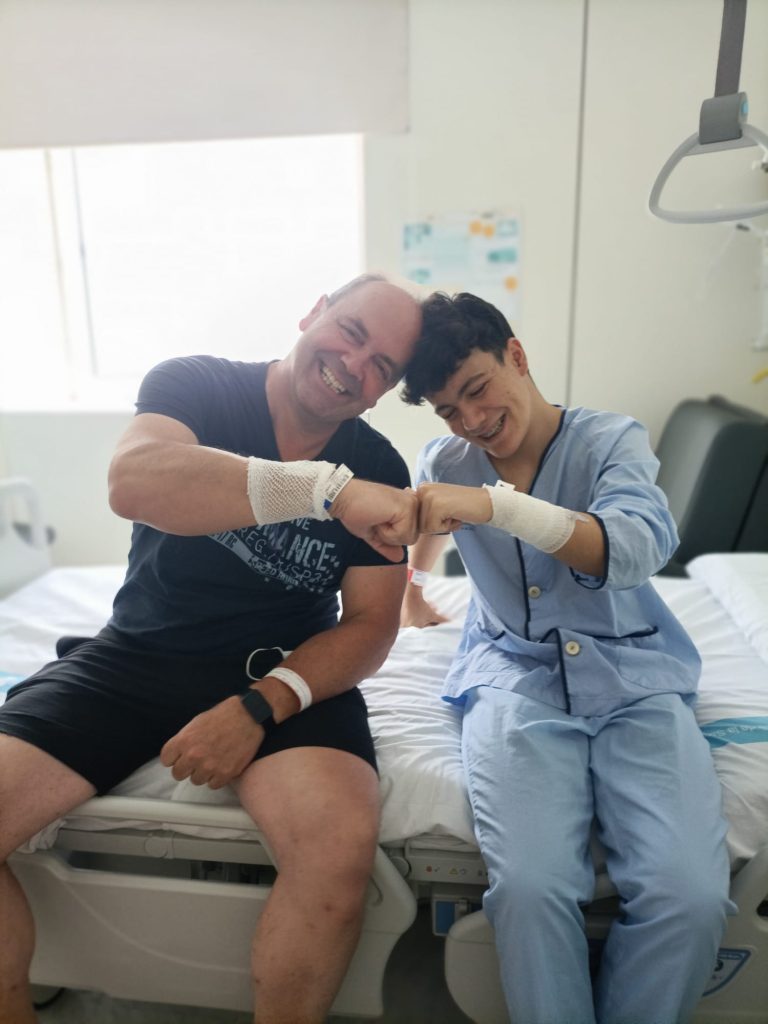
My 15-year-old son was born with familial hypomagnesemia with hypercalciuria and nephrocalcinosis, without ocular involvement.
He was diagnosed at 8 months of age after an episode of fever that led us to take him to a Pediatric Primary Care Center (CAP). During the evaluation, a routine urine dipstick test was performed, which came back positive. This raised suspicion of a urinary tract infection, and he was referred to the nephrology department of a large city hospital.
After being referred to the Nephrology Department of CST Hospital de Terrassa, an ultrasound revealed calcium deposits in his kidneys, and it was decided that the baby would be monitored closely.
The fever episode recurred a month later, and the urine dipstick test was repeated at the CAP. It was positive again, and antibiotics were prescribed. This alarmed me, and I was not satisfied with simply giving him antibiotics. I took my son to the emergency department at CST Hospital de Terrassa.
Children with this rare kidney disease always test positive on these urine dipstick tests because they constantly present hematuria and electrolyte abnormalities, even without having a urinary tract infection. I learned this later. In fact, it is possible that my son has never actually had a urinary tract infection.
In the emergency department, after additional tests revealed abnormal electrolyte levels, my son was admitted to the hospital. Although he no longer had a fever, he was not discharged until a week later, with a clinical diagnosis and an immediate request for genetic confirmation of FHHN, a rare kidney disease.
There were no patient registries or descriptions of this disease at the time. My son was possibly one of the first children registered in Spain with this condition, and the doctors had no previous cases to reference. He remained under the care and monitoring of these nephrologists for a year before being referred to a specialized center for rare kidney diseases: Vall d’Hebron University Hospital.
He was barely three years old. From that moment on, his medications and monitoring were significantly adjusted, and we experienced our first sense of relief knowing that he was in expert hands. At the same time, we received confirmation that there was no cure and that, sooner or later, he would require renal replacement therapy: dialysis or transplantation.
He had several serious hospital admissions during childhood because gastritis and common viral illnesses usually dehydrate healthy children, but in children with this rare kidney disease, dehydration translates into loss of kidney function. As a family, we learned more about the kidney and its functions, and how to live with our son and his diseased kidney, which we had to protect and preserve.
The Importance of Early Diagnosis and Treatment Adapted for Young Children
When the kidneys do not function properly, they stop efficiently eliminating waste substances and, at the same time, retain others that should be excreted through urine. In children with FHHN, excessive calcium and magnesium are lost, causing a significant electrolyte imbalance. Furthermore, the genetic alteration responsible for this disease also triggers hyperparathyroidism.
All these imbalances increase the risk of developing other diseases if preventive treatments are not applied to compensate for impaired kidney function. Without intervention, complications such as rickets, growth delay, bone weakening, tiredness, fatigue, lack of concentration, cramps, muscle pain, arrhythmias, and other serious health problems may occur.
When I learned all this, I realized the enormous importance of early diagnosis and how fortunate we had been. For this reason, we founded the Hipofam association.
In FHHN, as in many rare kidney diseases, so-called electrolyte supplementation is not a simple supplement, but an essential treatment. Therefore, it should be considered and recognized as such in order to receive adequate healthcare coverage.
The treatment is complex and highly demanding: it involves taking numerous pills every day. In my son’s case, he took up to 20 pills daily. Moreover, there are no formulations adapted for young children, who often have great difficulty swallowing tablets.
All of this makes daily life for families like ours, especially during childhood, extremely complicated, as we must constantly strive to comply correctly with the treatment and ensure that the child receives the doses their body needs.
Kidney Failure in FHHN
In my son’s case, we learned to grow up aware that the moment of kidney failure could arrive at any time. The struggle to preserve his kidney function for as long as possible was constant. Even so, he gradually lost it.
We learned that, in the face of kidney failure and the need for a transplant, transplantation is not necessarily a lifelong solution. In rare kidney diseases, pediatric nephrologists work intensely to preserve kidney function for as long as possible, with the goal of delaying dialysis as much as possible and preventing the patient from having to undergo multiple transplants throughout their life. This is especially important because each new transplant involves greater risks, and overall life expectancy is reduced in these patients.
My son experienced particularly severe episodes and multiple hospitalizations from a very young age. In one of them, without being able to prevent it or find a clear cause, his kidney function suddenly dropped from 75% to 40%. He was only three years old, and we were already facing the immediate possibility of dialysis or transplantation.
As a family, we learned to be different. We learned to live in a world made up of pills, schedules, heavy medication, and calendars marked by medical appointments. We learned to live with the silent threat of the day kidney failure would come… and yet, we also learned to be happy within that reality.
The Path Toward Renal Replacement Therapy
At the age of 13, we began to notice that something was changing. My son no longer had the same energy as before, and little by little, his kidney function began to deteriorate. For the first time, the doctors spoke to us clearly about renal replacement therapy—not as a distant possibility, but as a step we would have to face.
They explained something that was crucial for us: in pediatrics, there is a genuine “protection of childhood.” In other words, acting in time to avoid, whenever clinically possible, the need for dialysis and proceed directly to transplantation. Children are given priority on the waiting list. In Spain, we are also fortunate to have a leading organization in Europe and an international reference in transplantation: the National Transplant Organization, which coordinates and guarantees this exemplary model. In recent years, science has increasingly focused on a strategy that is offering better results in terms of graft duration and quality: living related donor transplantation. That was the option presented to us.
My husband and I then began the entire process of studies and tests to determine whether we were compatible. It was a long journey, full of tests, waiting, doubts, and fears… but also hope. Because when you live from childhood with a rare kidney disease, you learn that every decision, every check-up, and every transplant is not just a medical act: it is another opportunity to keep living.
Finally, my husband was selected as the best donor candidate, not only because he was compatible, but because his overall health and excellent kidney function made him an optimal donor. This gave us peace of mind knowing that the transplant offered the greatest possible guarantees, both for our son and for him. My son received the transplant in June 2025.
Transplantation is, without a doubt, a true opportunity for life. It allowed us to regain time, projects, and a certain sense of normality. But it also forced us—and still forces us today—to never stop learning.
Because transplantation is not a panacea. It is not a cure. To preserve the graft, it is essential to take lifelong immunosuppressive medication—drugs that are effective, but also potentially toxic and associated with significant side effects. These medications must always be adjusted, monitored, and controlled by expert teams, since even a small imbalance can put the transplanted kidney—or the patient’s health—at risk.
Moreover, each transplanted kidney has its own story. And each patient is different. No two transplants are the same. That is why every person requires specific and personalized medication guidelines, check-ups, and follow-up care.
For these young people, transplantation also marks a radical change in their lives. Overnight, they must become extremely responsible individuals: learning to manage their treatment, never forgetting a dose, recognizing warning symptoms, attending check-ups, accepting limitations, and caring for their bodies as never before. They quickly understand that transplantation is not the end of the struggle, but the beginning of a second stage: the daily fight to preserve that new kidney.
All this physical, emotional, and life burden cannot be faced alone.
The psychological impact is enormous, both for the recipient and for the donor. Fears, guilt, anxiety, pressure “not to fail,” fear of losing the graft, and, in the case of the donor, the need to process a deeply transformative experience all emerge.
For this reason, specialized psychological support for both donor and recipient should not be considered optional, but an essential part of the treatment itself, and it should be guaranteed within healthcare systems.
Turning Experience into Knowledge and Real Solutions
In this context, the collaboration between the Vall d’Hebron Research Institute (VHIR) and the Association for Information and Research on Familial Hypomagnesemia (Hipofam) marks this year ten years since the association’s first financial contribution—a turning point that made it possible to initiate a line of research that had been practically nonexistent until then.
The project was launched under the leadership of Dr. Anna Meseguer, head of the Renal Pathophysiology Group at VHIR, and Dr. Gema Ariceta, head of the Pediatric Nephrology Department at Vall d’Hebron University Hospital, with the aim of better understanding the disease and improving patient management.
This close alliance between healthcare professionals, researchers, and families has made it possible to build a solid project, sustained over time and focused on providing answers for a disease without specific therapeutic options.
“Collaboration with Hipofam has been key to promoting research that arises directly from the needs of patients and has a real impact on clinical practice,” emphasizes Dr. Gema Ariceta.
For the Hipofam patient community, working together, contributing samples, and raising funds for research has been—and continues to be—a true gateway to hope: the hope of finding a drug that, although it may not cure the disease, can halt or slow its progression toward kidney failure.
Statistics show that, at best, a kidney lasts on average about 15 years. If transplantation is performed during childhood, the patient will likely need more than one organ throughout their life, and life expectancy is reduced in these patients.
The project carried out at VHIR for FHHN is an advanced initiative aimed at better understanding familial hypomagnesemia with hypercalciuria and nephrocalcinosis (FHHNC), an ultra-rare genetic kidney disease that mainly affects children and young people.
Main Objectives
- Create new study models (patient-derived kidney organoids). These laboratory models replicate real characteristics of the affected kidney, allowing researchers to study the disease more precisely and test potential treatments in a controlled environment.
- Analyze variability among patients. Although all patients may share the same genetic mutation, the progression of the disease can be very different from one individual to another. The project seeks to unravel these differences in order to better understand who is at greater risk of rapid progression toward kidney failure and why.
Patient associations for rare kidney diseases play a fundamental role in the advancement of science and in the lives of those facing the inevitable progression toward kidney failure. Beyond offering emotional support and guidance, these organizations promote research, connect patients, and encourage the development of innovative therapies that may halt or slow the disease. Their work not only strengthens the voice of the community before authorities and healthcare professionals, but also generates hope and concrete resources to improve the quality of life of those living with these rare conditions.
by Susana Carvajal Arjona, Antoni’s mother.